Are Second-Hand Breast Pumps Safe? A UK Guide for Mums
If you're weighing up whether a second hand breast pump is a sensible buy, you're in very good company. With the cost of a baby adding up so quickly, it's only natural to look at Facebook Marketplace, eBay, NCT nearly-new sales and local mum groups for a bargain. A used pump can look almost identical to a brand-new one, and the price difference is often tempting. But before you hand over any money, it's worth understanding a little about how breast pumps are designed, because not all of them are safe to pass between users, regardless of how clean they appear.
I'm Olivia, an IBCLC (International Board Certified Lactation Consultant) based in London, and I have these conversations with mums most weeks. The honest answer is that it depends entirely on the type of pump. Some are genuinely fine to buy used with a few new parts; others should never be shared, no matter how good the deal looks. This guide walks you through the difference between open-system and closed-system pumps, what's safe versus what to avoid, exactly which parts to replace if you do buy used, and when it makes more sense to simply buy new.
Are Second-Hand Breast Pumps Safe? The Short Answer
Whether a used breast pump is safe comes down to one key question: is it an open-system or a closed-system pump, and is it designed for single users or multiple users? This is the single most important thing to understand before buying a 2nd hand breast pump, so let's break it down clearly.
Open-system vs closed-system pumps
An open-system pump has no barrier between the milk-collection parts and the tubing and motor. That means small droplets of milk, condensation or moisture can travel up into the tubing and, potentially, into the motor unit itself. Because you can't fully clean or sterilise the inside of a motor, an open-system pump can harbour residue you simply cannot see or reach. These pumps are designed for one user only.
A closed-system pump has a barrier (often a backflow protector or membrane) that stops milk reaching the tubing and motor. Hospital-grade multi-user pumps take this further still: they're engineered to be shared safely between different mums, provided each mum uses her own personal kit. That's why you'll see them rented from the NHS, hospitals and lactation services.
| Feature | Open-system (personal) | Closed-system / hospital-grade (multi-user) |
|---|---|---|
| Barrier between milk and motor | No | Yes |
| Risk of milk reaching tubing/motor | Possible | Designed to prevent it |
| Safe to share between mums? | No — single user only | Yes, with each mum's own kit |
| Where you'll usually see them | Most retail wearable & personal pumps | NHS, hospitals, lactation services (rentals) |
| Buying used privately? | Best avoided | Only via official rental, not private resale |
The takeaway: a personal, single-user pump bought second-hand from a stranger carries a genuine cross-contamination risk if it's an open-system design, because you can't verify what's inside the motor. A multi-user hospital-grade pump is built differently, but those are rented through official channels rather than sold privately on Marketplace.
The Real Hygiene Concern: Cross-Contamination
I want to be balanced here, not alarmist. The worry with a shared single-user pump isn't the parts you can wash, sterilise or replace, those are easy to sort. The concern is the parts you can't reach: the inside of the tubing on an open-system model, and the motor unit. If milk residue has travelled into those areas during the previous mum's use, there's no reliable way to clean it out. Over time, trapped moisture and milk residue can support bacterial or mould growth, and breast milk can carry viruses that pose a risk to a baby.
This is why the consistent guidance, echoed in NHS information and by pump manufacturers, is straightforward: never share a personal, single-user (open-system) breast pump, even between friends or family. It's not about how careful or clean the previous owner was; it's about the design of the device itself.
What this means in practice
- A used personal open-system pump from a private seller is best avoided altogether.
- A closed-system personal pump is lower-risk than open-system, but it was still designed for a single user, so most manufacturers don't recommend sharing it either.
- An official hospital-grade rental is the genuinely safe "shared" route, because the motor is sealed off and you supply your own personal collection kit.
What's Safe vs What to Avoid
Here's a clear, no-nonsense summary you can screenshot before you start scrolling Marketplace.
Generally safe
- Renting a hospital-grade pump through the NHS, a hospital, or an accredited lactation service, with your own brand-new personal kit.
- Buying a brand-new pump that's sealed in its original packaging.
- Buying a used multi-user pump's motor only if it's a true closed/multi-user system and you fit a complete set of new personal parts (still check the manufacturer's stance).
Best avoided
- A used open-system personal pump from any private seller (Facebook Marketplace, eBay, car-boot, NCT sale, friend or relative).
- Any pump where you can't tell whether it's open- or closed-system.
- A pump with no visible backflow protector or membrane between the milk and the tubing.
- A heavily used pump with a tired motor, even closed-system motors lose suction over time, which can affect your milk supply.
- A pump sold with the original personal parts "thrown in" as a selling point. Those should never be reused by a new mum.
Buying a Used Pump: What to Replace
If you've established that a pump is a closed/multi-user system and you still want to buy the motor unit second-hand, you must fit a complete set of brand-new personal parts. Reusing someone else's collection parts is never acceptable, regardless of how clean they look. Here's your replacement checklist.
| Part | Replace before use? | Why |
|---|---|---|
| Valves | Always | Direct milk contact; degrade and harbour residue. |
| Membranes / diaphragms | Always | Direct milk contact; thin silicone perishes. |
| Tubing | Always (and a deal-breaker for open-system) | Can hold moisture and milk you can't see or clean. |
| Flanges / shields | Always | Direct skin and milk contact. |
| Bottles / collection cups | Always | Direct milk contact; replace, don't just wash. |
| Backflow protectors | Always (closed-system) | Their whole job is to stop milk reaching the motor. |
| Motor unit | Cannot be replaced or fully cleaned | This is why open-system used pumps are best avoided. |
Before you commit, also weigh up the practical hidden costs. By the time you've bought new valves, membranes, tubing, flanges, inserts and bottles for an older pump, plus factoring in a motor that may already have lost some of its suction, the saving over a new pump can shrink dramatically. A new motor matters too: weak suction can mean longer pumping sessions and, in some cases, a knock to your supply.
Second-Hand Safety Checklist
If you're still tempted by a used listing, run through these questions first:
- Is it clearly a closed-system or multi-user pump? If you can't confirm, walk away.
- Can I see a backflow protector or membrane separating the milk from the tubing?
- Am I prepared to buy a full set of new personal parts before first use?
- How heavily was the motor used, and is the suction still strong?
- Once I add the cost of new parts, am I genuinely saving money versus buying new?
- Is there any warranty or returns protection? (Private sales almost never have this.)
When It Makes More Sense to Buy New
For most mums, a brand-new personal pump is the simplest, safest and often the most cost-effective choice once you've added up replacement parts. Buying new gives you a sealed, untouched motor, a full warranty, and complete peace of mind during what's already a busy season of life.
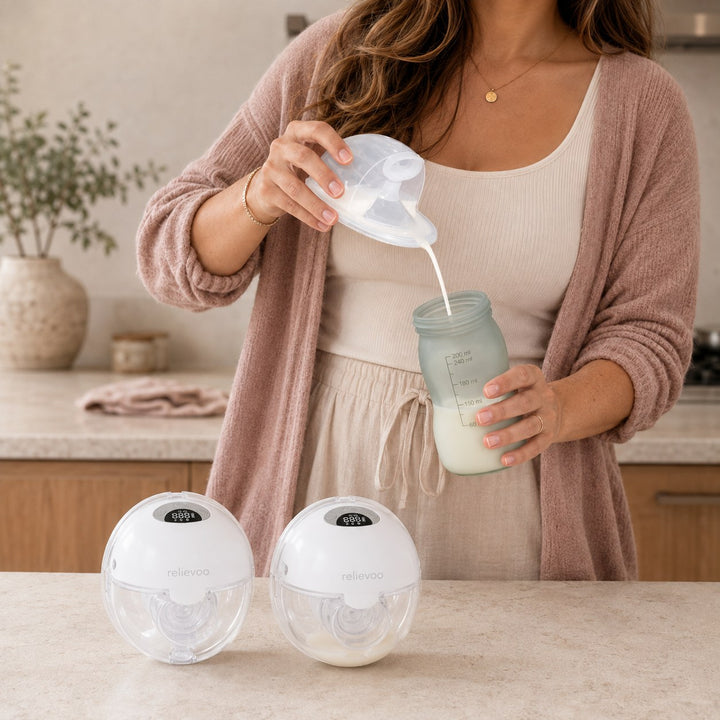
This is where a well-designed modern wearable can make the decision easy. The Relievoo Wearable Hands-Free Breast Pump PRO2 is a double, cordless, in-bra pump with a closed, hygienic design, so there's no question mark over hidden residue. It offers 4 modes and 9 suction levels (up to 300 mmHg), runs at under 35 dB, and gives around 6 oz per cup with up to 240 minutes of battery (90 minutes to recharge via USB-C). It comes with a 24mm shield plus five inserts (13, 15, 17, 19 and 21mm) so you can find a comfortable, effective fit, and it's CE, UKCA, BPA-free and made from food-grade silicone.
Just as reassuring for the budget-conscious: it's backed by a Free Lifetime Warranty on the motor and a 30-Day Money-Back guarantee, with Free UK Shipping in 3-5 business days. That combination, a sealed new motor, a hygienic closed system and a warranty, is precisely what a used listing can't offer. If you'd like a fresh-from-the-box option without the hidden costs of refurbishing someone else's pump, you can see the Relievoo PRO2 here.
Frequently Asked Questions
Are second-hand breast pumps safe to use?
It depends on the type. Single-user open-system pumps are best avoided second-hand, because milk can travel into the tubing and motor where it can't be cleaned, creating a cross-contamination risk. Closed-system and hospital-grade multi-user pumps are designed differently, but personal pumps are still meant for one user. The genuinely safe shared route is renting a hospital-grade pump with your own new kit.
Can I buy a used breast pump on Facebook Marketplace or eBay in the UK?
You can, but be cautious. Most pumps sold privately are single-user open-system models that aren't recommended for sharing. If a listing doesn't clearly state it's a closed or multi-user system, and you can't fit a complete set of new personal parts, it's safer to buy new or rent a hospital-grade pump.
What parts do I need to replace on a second-hand pump?
At a minimum: valves, membranes or diaphragms, tubing, flanges or shields, bottles or collection cups, and backflow protectors. The motor unit cannot be replaced or fully cleaned, which is exactly why open-system used pumps are best avoided. Never reuse another mum's personal parts.
Is it cheaper to buy a used breast pump?
Sometimes, but less than you'd think. Once you've bought a full set of new personal parts and accounted for a motor that may have lost some suction, the saving over a new pump can be small. Factor in the lack of warranty on a private sale, and buying new often works out better value overall.
Can I share a breast pump with a friend or family member?
Not if it's a personal single-user pump, even between close family. The concern is the motor and tubing you can't clean, not the parts you can wash. If you both need a pump, the safe option is for each mum to have her own, or to rent a hospital-grade multi-user pump with separate personal kits.
How do I know if a pump is open-system or closed-system?
Look for a backflow protector or membrane that separates the milk-collection parts from the tubing, that's the hallmark of a closed system. Check the manufacturer's specifications or manual, which usually state it clearly. If you can't confirm it's closed-system, treat it as open-system and don't share or buy it used.