The Family and Medical Leave Act (FMLA) gives many US employees up to 12 weeks of job-protected, unpaid leave after having a baby. For a lot of moms in my Austin practice, that means returning to work while still very much in the thick of breastfeeding. The good news: federal law is on your side, and with a little planning, pumping at work becomes a routine rather than a daily scramble.
Know your rights before day one
The PUMP for Nursing Mothers Act expanded protections so that most employees are entitled to reasonable break time and a private, non-bathroom space to pump for up to one year after the baby's birth. The U.S. Department of Labor publishes clear guidance you can share with HR. Knowing this in advance makes the conversation with your manager far easier.
Talk to your employer early
Two to three weeks before your return, email your manager or HR to confirm a private space and flexible break times. Frame it as logistics, not a favor — you're entitled to it, and a short, matter-of-fact note usually does the trick.
Build a schedule that mirrors your baby
A newborn typically feeds every 2-3 hours, so aim to pump roughly as often as your baby would eat. For most moms returning around 12 weeks, that's about three sessions across a standard workday.
- Mid-morning (around 10 a.m.)
- Lunch (around 12:30 p.m.)
- Mid-afternoon (around 3 p.m.)
Each session runs about 15-20 minutes. Consistency protects your supply far more than the length of any single session.
Why a wearable pump changes the math
The single biggest complaint I hear about pumping at work is the "tethered" feeling — sitting still, plugged into a wall, watching the clock. A cordless, in-bra wearable lets you answer email, join a call on mute, or walk to a meeting while you pump.
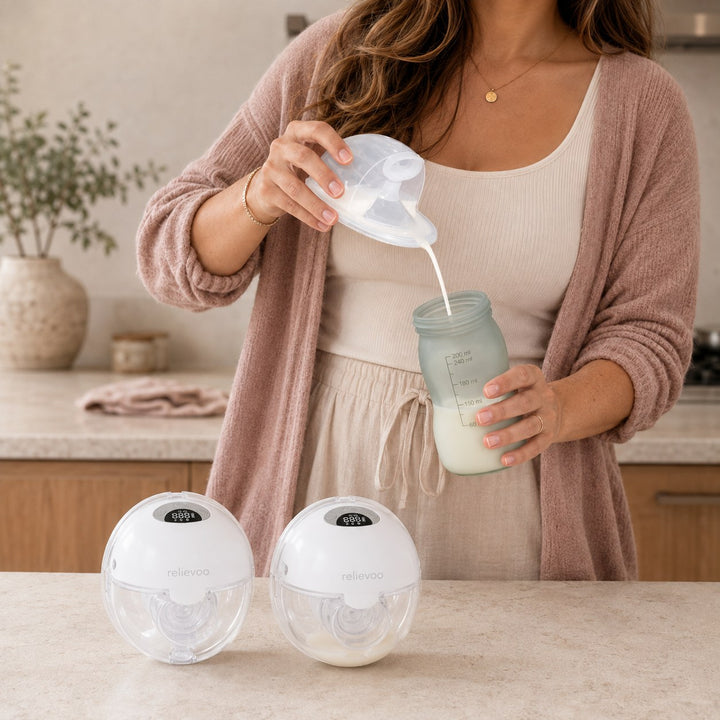
Shop: TheRelievoo Wearable Breast Pump (Double) — hands-free, under 35 dB — free USPS tracked shipping, 30-day money-back and a lifetime warranty. Independently lab-tested for quiet, comfortable use.
Quiet operation matters in an open office. A pump under about 35 dB is roughly the level of a whisper, so colleagues won't hear it through a door. Pair it with a discreet carrying case so your kit travels neatly between home, car and office.
Storing and transporting milk
Follow the CDC breast milk storage guidelines: freshly expressed milk keeps at room temperature for up to 4 hours, in a cooler with ice packs for up to 24 hours, and in the refrigerator for up to 4 days. A small insulated bag with ice packs covers most commutes. Reusable storage bags cut down on waste and label neatly with the date.
Common mistakes to avoid
- Skipping sessions to "power through" a busy day — this is the fastest way to dip your supply.
- An ill-fitting flange, which reduces output and causes soreness. If you're not sure of your size, a set of flange inserts lets you dial it in.
- Not practicing before your first day. Do a couple of dry runs at home so the routine feels automatic.
Frequently asked questions
How many times should I pump at work?
Roughly every 3 hours, or about three times across a standard 8-hour day.
Does my employer have to pay me for pumping breaks?
Break time is usually unpaid unless your employer already offers paid breaks, but the time and space must be provided. Check the DOL guidance for details.
Will pumping at work hurt my supply?
Not if you pump consistently. Regular, complete sessions signal your body to keep producing.
Returning to work is a big transition, but it's one you can absolutely navigate while continuing to breastfeed.
Written by Jessica Nolan, IBCLC — International Board Certified Lactation Consultant (Austin, Texas). Jessica is a mom of two who has supported 500+ American families with breastfeeding, pumping and the return-to-work transition. She is a member of the United States Lactation Consultant Association (USLCA) and works alongside local La Leche League USA groups.
Clinically reviewed by Dr. Rachel Adams, MD, FAAP (Austin, Texas). This article is educational and is not a substitute for advice from your OB-GYN, pediatrician or IBCLC.